
2026 AIANS Design Awards Program
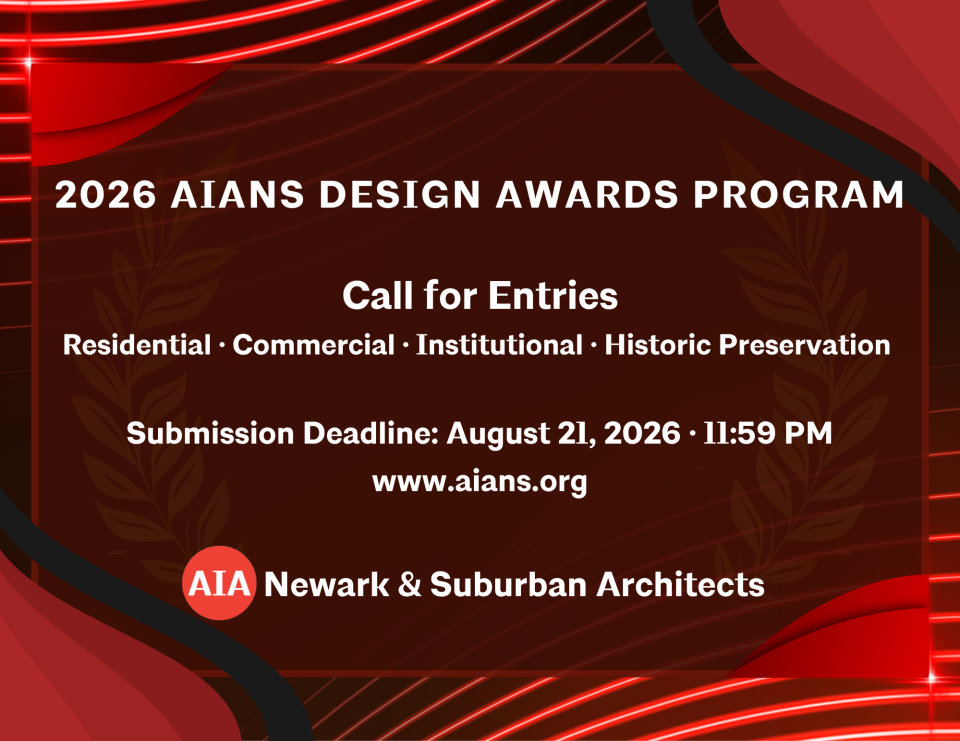
Welcome to 2026 design awards
The 2025 Design Awards Ceremony will be held at the beautiful and historic Orange Lawn Tennis Club in South Orange, on September 24th, from 6 - 9 PM.
2026 Student edition please click the link below!
https://aians.org/form.php?form_id=139&c=1
AIANS Member SUBMISSIONS
If you run into any issues submitting your projects, please contact us directly at [email protected]!
First entry is $80. Each additional entry is $60.
PLEASE NOTE! PLEASE DO NOT UPLOAD FILES MORE THAN 35 MB! THANK YOU!
1st Entry: HERE
2nd Entry: HERE
3rd Entry: HERE
4th Entry: HERE
5th Entry: HERE
6th Entry: HERE
7th Entry: HERE
8th Entry: HERE
Submission deadline is August 21 at 11:59pm!!
Please contact Director Robert Epstein if you run into any issues uploading your materials: [email protected]
submission categories
The 2026 design awards include two main categories: small projects (under $500,000) and large projects (more than $500,000), which are further classified as built or unbuilt. Each main category includes subcategories for residential, commercial, institutional, and historic preservation projects.
PLEASE NOTE: TOTAL COSTS OF CONSTRUCTION EXCLUDING DESIGN FEES.
Small Project (Built)
Eligibility: Projects $500,000 or less. This category includes interior design, built specialty fabrications, art installations, furniture elements, sculptures; objects that are not necessarily buildings or spaces but are created by architects.
-
Residential
-
Commercial
-
Institutional
-
Historic Preservation
Small Project (UnBuilt)
Eligibility: Projects $500,000 or less. This category includes interior design, built specialty fabrications, art installations, furniture elements, sculptures; objects that are not necessarily buildings or spaces but are created by architects.
-
Residential
-
Commercial
-
Institutional
-
Historic Preservation
Large Project (Built)
Eligibility: Projects more than $500,000. This category includes interior design and architecture.
-
Residential - Single Family and Multi Family
-
Commercial
-
Institutional
-
Historic Preservation
Large Project (UnBuilt)
Eligibility: Projects more than $500,000. This category includes interior design and architecture.
-
Residential - Single Family and Multi Family
-
Commercial
-
Institutional
-
Historic Preservation
Residential: New construction, additions, renovation and alterations that are designed or built for single family and multi family residential projects. This includes architecture and interior design.
Commercial: New construction, additions, renovation and alterations that are designed or built for business clients such as offices, retail, restaurants, mixed use, etc. This includes architecture and interior design.
Institutional: New construction, additions, renovation and alterations that are designed or built for religious, government or educational clients.This includes architecture and interior design.
Historic Preservation: Entries will be evaluated based on the design's sensitivity to the historic character and fabric of the property, as well as the degree of preservation or restoration achieved. Projects should represent best practices and the use of appropriate techniques in their execution. The evaluation will consider the degree of difficulty of the problems or threats faced and the creativity and appropriateness of the solutions applied. Additionally, the impact of the project leader, program, organization, or property on the community and the preservation of the resource will be assessed.
Eligibility
Architects-The program is open to registered architects who are regular members or professional associate members in good standing of AIA Newark and Suburban Architects. Submissions can be by members in a joint venture (JV) with another firm, however, both parties to the joint venture must be directly involved in the design process, from start to finish, i.e. the Design Architect not the Architect of Record.
Built By- All projects must have been built or designed (if unbuilt) after January 1, 2021.
Resubmission- Projects that meet the Built-By date requirement that have been previously submitted may be resubmitted only if they didn’t receive any rewards or commendation in previous design awards programs.
Submission Format
-
Submissions are to be formatted for printing on 40” x 40” boards
-
Printed boards are required and will be presented at the awards ceremony.
-
The entry must be submitted in 2 separate files. Files must be titled with the version name:
-
“Jurors’ Version” must have all names or references to your firm removed.
-
“Presentation Version” may have all your firm or school names and logos included. The Presentation Version should have the name/logo of the architect located in the bottom 2” of the board.
-
All versions of boards should feature:
-
the name of the project,
-
if it is built or un-built,
-
the location,
-
a description of the project,
-
text as to the unique challenges and response,
-
Date of construction or design
It is strongly recommended (but not required) to limit text and focus on descriptions of the design challenge and the architect’s specific response - avoid text focused on marketing. Boards are most successful when they are:
-
Accompanied by site and floor plans, circulation diagrams, conceptual diagrams, exterior or interior elevations, and sections, select details, (if possible) photographs (provide credits for all photographs.)
-
State the problem and your solution, and reinforce that with the images you choose
-
Organized to be easy to read and tell the story of the design. Providing legends, titles, references, call outs and blow ups where appropriate make it easier to understand your design.
-
Color coded CAD drawings are customary, and hand drafted drawings, sketches, paintings, models and renderings can help set projects apart.
Jurors and Judging
The jury shall be comprised of distinguished professionals from around the region or the country. All jurors shall recuse themselves if they have prior prejudicial knowledge of the project or the architect responsible for the design. The jury shall be sent the “Jurors’ Version” of all the projects electronically. The deliberations will be moderated by the Design Awards chairperson who will provide basic guidelines. The criteria for awards will be left to the jurors’ experience and discretion. There will be no requirements for the number or level of awards in any category.
Jury criteria
Residential, Commercial, Institutional:
-
Presentation Clarity and Quality – Evaluate the overall clarity and quality of the presentation, emphasizing clear visuals and coherent narratives.
-
Design Excellence and Execution – Assess the design's creativity, aesthetics, and craftsmanship, focusing on how well it meets project requirements.
-
Sustainability and Resilience – Consider the project's environmental performance, use of sustainable materials, energy efficiency, and adaptability to changing conditions.
-
Community and Contextual Impact – Examine the project's integration with its surroundings, cultural context, and positive impact on the local community.
-
Innovation and Ambition – Evaluate the project's use of new technologies, innovative solutions, and ambitious vision to push architectural boundaries.
Historic Preservation:
-
Preservation and Protection – Evaluate the overall clarity and quality of the presentation, emphasizing clear visuals and coherent narratives.
-
Design Sensitivity – Project design sensitivity to the historic character and fabric of the property and the degree of preservation or restoration achieved.
-
Best Practices – Execution of the project representing best practices and the use of appropriate techniques.
-
Problem Solving – Degree of difficulty of problems or threats faced and the creativity and appropriateness of solutions applied.
-
Community Impact – Impact of the leader, program, organization, or property on the community and the preservation of the resource.
Awards
Projects may be recategorized by jurors based on nature and number of entries.
Participants must pick one category that best represents the entry or client. The registration form must indicate if the project is built or unbuilt. An effort will be made to award a medal to each category based on quality of submissions, however there is a possibility that not all categories are receiving an award.
Architects whose projects are selected for recognition will be awarded with an AIANS insignia medal and ribbon ranked Gold, Silver, or Bronze along with a certificate, or a printed certificate of recognition for Merit.
